While in previous years there were still theaters willing to screen films from the Israeli Seret Film Festival, and public funding was also available, this year is different. The festival is being held in a synagogue and a sponsoring hotel.
For years, De Balie had been a willing host for the film festival, resulting in protests outside its doors and a media uproar. Back in 2022, we already pointed out the hypocrisy of severing ties with Russia so quickly after their invasion of Ukraine. Apparently, however, one military occupation is less bad than another. Because Israel still receives ample economic and military support from the Netherlands and the EU.
Seret is artwashing.
The Seret Film Festival is sponsored by various institutions directly and indirectly linked to the Israeli government: the Israeli Embassy, the Israeli House (part of the Israeli Ministry of Aliyah, the Ministry of Immigration), the Israeli Film Fund, and Masa Israel Journey of the Jewish Agency for Israel, the operational arm of the World Zionist Organization. Another sponsor, the Rabinovich Foundation, even censors artists by contractually prohibiting them from mentioning Israeli apartheid or the Nakba (the “catastrophe,” as Palestinians refer to their expulsion from Palestine in 1948).
Israeli events must be rescheduled
The protests have paid off: Amsterdam stopped providing funding in 2023, and today Amstelveen has also stopped funding the festival. The festival can no longer secure public venues—other Israeli events in the city have also had to find alternative locations, such as the performance by “comedian” Yohay Sponder, who was no longer welcome at Boom Chicago and subsequently found a small backroom venue in Amstelveen. Wherever artists supported by Israel perform, or events sponsored by Israel take place, they will face protests. Every time, we pull back the curtain and expose the hypocrisy and reveal what this is really about.
The Palestinian Campaign for the Academic and Cultural Boycott of Israel (PACBI), a founding member of the Palestinian-led BDS movement, endorses the growing, organic consumer boycott of Spotify, the world’s largest music streaming service, which directly profits from artist exploitation, systems of mass deportation, apartheid, and genocide.
In October 2025, Spotify users began to hear racist recruitment ads for the U.S. Immigration and Customs Enforcement (ICE), as the agency continues to terrorize immigrant communities and those in solidarity with them across the country. Though the ICE ads have reportedly expired, Spotify has refused to change its policies, defending the ads as consistent with their company standards.
Later that year, Spotify reportedly ran ads for genocidal Israel’s prison service, recruiting armed units. Under the direct control of racist fanatic Israeli government minister Itamar Ben-Gvir, Israeli prisons and detention centers have increased the widespread and systemic use of physical torture, psychological abuse, inhumane detention conditions, and sexual violence against Palestinian political prisoners.
Spotify’s complicity in Israeli apartheid goes much deeper than the typical lifecycle of these unethical and potentially illegal ads. The company launched in the Israeli market with a multi-year deal with Partner Communications Company Ltd, an Israeli telecommunications company listed in the United Nations’ database of businesses involved in illegal Israeli settlements on occupied Palestinian land. Any such deal violates the 2024 International Court of Justice ruling that Israel’s entire presence in the occupied Palestinian territory, including East Jerusalem, is illegal and amounts to apartheid. Failure of corporations to comply with international law may also constitute criminal complicity, according to leading legal experts.
Spotify is also among the leading platforms that have hosted genocidal Israeli government propaganda including Mission Brief: The Official Podcast of the Israel Defense Forces.
Spotify’s founder (and CEO until December 2025), Daniel Ek, is the chairman of German military AI company Helsing, and has personally invested his wealth gained from Spotify into the company, helping to raise hundreds of millions of dollars for it to expand. Despite the company’s claim that its technology is not currently used “in war zones other than Ukraine,” Helsing has directcontracts with multiple international arms companies that are complicit in genocidal Israel’s regime of apartheid and military occupation, including Rheinmetall,Saab and Airbus. Airbus is involved in the militarized policing and surveillance of the US-Mexico border, and its subsidiary Airbus DS Airborne Solutions has a long-term strategic partnership with the state-owned Israel Aerospace Industries.
Spotify has long been notorious in the music industry for its poverty wages, rigged algorithms allegedly prioritizing major labels, and demonetization of the vast majority of songs in its extensive catalogue. We recognize that artists are not all in a position to pull their music entirely from the platform, given its near-monopoly over crucial metrics used by the industry at large. But we welcome those who are withdrawing from the platform, and we endorse the subscriber boycott and call for it to be deepened. We also urge artists to echo our demands, at a minimum.
With enormous wealth extracted from musicians’ labor invested by Spotify’s founder into AI warfare with links to Israel’s genocide; Spotify running ads for militarized, racist forces in the US and Israel; normalizing genocide and apartheid; as well as trapping artists in an exploitative system without fair pay, the case for music fans to unsubscribe from Spotify is more compelling than ever.
We call on all people of conscience to apply strategic pressure on Spotify, including canceling Spotify subscriptions and deleting Spotify accounts, until the company:
Adopts an intersectional ethical programming, advertising, sponsorship, and partnership policy, which prohibits platforming companies, agencies or services verifiably complicit in human rights violations, including apartheid and genocide.
Ends all business with Partner Communications and all other Israeli companies complicit in Israel’s apartheid, illegal occupation, and genocide.
Genocide, apartheid, exploitation and racist deportations should never be on the playlist.
This call comes from PACBI, the Palestinian Campaign for the Academic and Cultural Boycott of Israel. PACBI is one of the founders of the broader BDS movement (Boycott, Divestment and Sanctions) — a nonviolent movement established by Palestinian civil society that aims to pressure Israel through boycotts, just as the apartheid regime in South Africa was boycotted globally in the 1980s.
A few terms that appear throughout this text:
Cultural boycott. The idea is simple: artists are asked not to perform in Israel as long as Palestinian human rights are being violated, and not to collaborate with institutions that contribute to those violations. This is the same approach used against South Africa at the time, when many artists refused to play Sun City.
Artwashing. This means using art, music, and major shows to project a cheerful, normal, and attractive image of a country that is simultaneously committing serious crimes. The glamour of a concert diverts attention from what is actually happening.
PACBI is calling for targeted, strategic pressure on Live Nation Entertainment — the world’s largest concert and festival organiser — until the company takes responsibility for what PACBI calls its complicity in the war in Gaza.
For Dutch readers: Live Nation is closer to home than you might think. In the Netherlands, the company operates under the name Mojo Concerts. Mojo organises events including Pinkpop, Lowlands, Down The Rabbit Hole, North Sea Jazz and Bospop, owns venues such as the Ziggo Dome and AFAS Live, and also owns ticketing platform Ticketmaster. There’s a good chance you’ve bought a ticket for an event that ultimately traces back to Live Nation.
How Live Nation gives a dictatorship a makeover
For more than ten years, Live Nation Israel has been a driving force behind international artists performing in Israel — and thereby ignoring the nonviolent call from Palestinian civil society to do precisely the opposite. Live Nation Israel was formed when Live Nation acquired a majority stake in Israeli company Bluestone Entertainment.
Artists who performed there include major names such as Imagine Dragons, Christina Aguilera, the Backstreet Boys, Maroon 5, and Bon Jovi. They often played at venues like Hayarkon Park and Live Park in Rishon LeZion — locations built on the remains of Palestinian villages whose residents were expelled.
More recently, Live Nation Israel publicly declared its support for the Israeli military, stating it stood “behind the IDF soldiers and security forces” at the moment that army was carrying out what is described as the first phase of the genocide in Gaza. The UN Commission of Inquiry and the International Association of Genocide Scholars are among the most recent bodies to characterise what is happening in Gaza as genocide.
Who else is involved
The money flows behind Live Nation run deep. Keeping it brief, the key connections are:
Live Nation’s largest shareholder is the American conglomerate Liberty Media. A Liberty investment fund puts money into Israeli tech, cyber, and telecom companies — sectors with close ties to the Israeli military and intelligence services.
The next two largest institutional investors are The Vanguard Group and BlackRock. Both are named in a recent UN report for major investments in companies that profit from the occupation and the war — including Palantir, Lockheed Martin, and Caterpillar. These same investors also hold stakes in other entertainment companies, such as Netflix, Disney, and cinema chain AMC.
Several Live Nation board members also have ties to Israeli politics and industry. A recently added board member is Richard Grenell, a close adviser to President Trump and an outspoken supporter of Israel. Other board members have ties to Liberty Media or to Israeli tech companies.
The point: this is not one isolated misstep, but a web of financial and governance connections.
This is bigger than one company
Live Nation has been under fire for years — from artists, fans, and crew alike. And it’s not only about Gaza.
A (near-)monopoly. When Live Nation merged with Ticketmaster, it triggered a lawsuit from the US Department of Justice; forty US states accused the company of running an illegal monopoly. A separate case from the US competition authority followed, concerning unfair ticket trading. Amid all that litigation, Live Nation reportedly donated half a million dollars to Trump’s inauguration.
Familiar in the Netherlands: Live Nation (via Mojo) dominates the market here too. The company organises the major festivals, owns the major venues, and controls Ticketmaster. Independent organisers and smaller festivals have long complained that exclusivity contracts make it near-impossible to compete. Fans grumble about Ticketmaster’s high service fees and “dynamic” pricing, where ticket prices rise as demand increases.
Exploitation. Leveraging its dominant position, Live Nation drives a hard bargain. In a leaked memo, the company used the COVID pandemic as a pretext to cut artist fees and claim a hefty share of merchandise revenue. Musicians and crew have seen their wages stagnate or fall for years, while the company continues to profit from ever-rising ticket prices.
Homogenisation of the music landscape. Critics argue that Live Nation’s dominance hollows out local music scenes and makes everything look the same. In Portland, Maine, local promoters and musicians’ unions successfully blocked the construction of a new Live Nation venue. PACBI sees such struggles as part of the same broader fight and supports these initiatives.
The demands
PACBI is calling for strategic BDS pressure on Live Nation Entertainment until the company:
shuts down Live Nation Israel, its Israeli subsidiary;
applies the same ethical standards across its entire network regarding who it programmes and partners with;
respects PACBI and BDS movement guidelines and positions across its entire network.
What we ask of venues and festivals
Festivals and venues that are part of — or run or programmed by — Live Nation cannot simply detach themselves from the parent company. They have little influence over major decisions. But that is precisely why they are well-placed to make a difference, and why PACBI argues they have a moral obligation to do so.
We therefore ask all venues and festivals affiliated with Live Nation to:
Publicly call on Live Nation to shut down its Israeli subsidiary;
Introduce their own ethical standards for programming and partnerships, following PACBI/BDS guidelines — regardless of what the parent company decides;
Publicly condemn the complicity of Live Nation’s investors.
We will continue applying pressure to these festivals and venues until all of these points are met.
What we ask of artists, fans, and staff
Artists: pressure Live Nation’s festivals and venues to meet the demands above.
Fans, festival-goers, and audiences: help this campaign grow and spread the message.
Staff and crew: we stand with you. We hope you find ways to raise these demands within your own organisations.
The moment is now
As the war in Gaza enters its third year, the urgency of confronting complicity with injustice — including in the music and events industry — has never been greater.
And the movement is growing, including close to home:
Eurovision Song Contest. For the first time in 24 years, the Netherlands did not participate in 2026. Dutch broadcaster AVROTROS withdrew because Israel was admitted by the EBU, citing the humanitarian suffering in Gaza, the erosion of press freedom, and political interference. Spain, Ireland, Slovenia, and Iceland also stayed away for the same reasons. A significant portion of the “Eurovision family” was thus absent from the world’s biggest live music event.
No Music for Genocide. More than a thousand artists and labels have now blocked their music from streaming in Israel through this campaign, including major names such as Björk, Paramore, and Lorde.
Previous successes. Strategic BDS pressure has also worked against Live Nation before. Last year, artist and fan boycotts led the controversial bank Barclays to stop sponsoring Live Nation festivals in the United Kingdom. And over the past decade, artists including Beyoncé and Shakira cancelled previously announced shows in Israel — concerts that had been organised by Bluestone/Live Nation Israel.
Live Nation must finally take responsibility for the damage that PACBI says its years of artwashing have caused.
There must be no platform for genocide or apartheid.
This text is an adaptation for the Dutch context of the call by PACBI (Palestinian Campaign for the Academic and Cultural Boycott of Israel) to apply pressure on Live Nation. The factual claims and standpoint are those of the campaign itself.
The Palestinian BDS National Committee (BNC), the broadest Palestinian coalition leading the global BDS movement, officially endorses the grassroots, organic campaign to boycott ZARA. We call on people of conscience around the world to boycott ZARA, the flagship brand of the Spanish multinational Inditex, for its deep and growing complicity in Israel’s regime of settler-colonialism, apartheid, and genocide.
At the start of 2025, amid Israel’s ongoing genocidal assault on Palestinians in Gaza, ZARA opened its largest-ever store in Israel – a 4,500 m² flagship in the Big Fashion Glilot complex near Tel Aviv. This expansion deepens ZARA’s economic ties with Israel, where the brand already operates dozens of stores. It comes at a time when Israel’s genocidal regime is carrying out mass killings, forced displacement, and the destruction of Palestinian cultural life with full impunity. Israel’s attack on Gaza has, to date, killed an undercount of over 80,000 Palestinians and has obliterated the Strip’s healthcare and education systems, devastating its social, cultural, and economic fabric, deliberately inflicting conditions of life in Gaza calculated to bring about the physical destruction of Palestinians.
ZARA’s complicity with Israel’s regime of oppression runs deeper still. In October 2022, Joey Schwebel, chair of Trimera Brands, ZARA’s Israeli franchisee, hosted a campaign event at his home for far-right Israeli minister Itamar Ben-Gvir. Ben-Gvir, who has openly called for the expulsion of Palestinians, the shooting of civilians, and the denial of humanitarian aid to Gaza, was cited in the International Court of Justice’s case, which found that Israel is plausibly committing genocide. Following the event, Ben-Gvir praised ZARA, tweeting: “ZARA, beautiful clothes, beautiful Israelis.”
In June 2021, ZARA Woman’s then-head designer, Vanessa Perilman, launched a racist tirade against Palestinians in Instagram messages to Palestinian model Qaher Harhash. ZARA responded with a weak public statement distancing itself from the remarks but took no meaningful action or accountability.
In December 2023, ZARA released an offensive ad campaign titled “The Jacket,” depicting mannequins wrapped in white shrouds next to crumbled statues, imagery eerily similar to that of shrouded Palestinian bodies seen daily in Israel’s livestreamed genocide in Gaza. Following international outrage, ZARA removed the ad and issued a hollow “apology,” stating it “regretted the misunderstanding,” while doing nothing to address its deep business ties to Israel’s apartheid regime.
ZARA and Inditex have remained silent on Israel’s destruction of Gaza’s cultural sector and 4,000-year-old cultural heritage. They have said nothing about the killing of Palestinian fashion and textile figures, including Israel’s assassination of renowned designer Walaa al-Afranji, founder of Fashion Room by Walaa, along with her husband in Nuseirat refugee camp in December 2024. At the same time, ZARA chose Israeli model Sun Mizrahi to front its global campaign in 2024, whitewashing Israel’s crimes by glamorizing its image during a genocide. Commenting on ZARA’s campaign, a spokesperson for Mizrahi said that “[she] is happy to be the Israeli face so identified with our country around the world, especially in such times.”
Inditex’s complicity in human rights violations extends beyond Palestine. The company has been linked to abusive labour conditions in Brazil, and to allegations of workers’ rights violations in Myanmar, forcing the company to quit the country after a public pressure campaign. These cases form part of a wider pattern of Inditex’s failure to uphold basic rights across its global supply chains.
As highlighted in a legal analysis by Dr. Irene Pietropaoli for SOMO and Al-Haq, executives of corporations worldwide can be held legally accountable for complicity in Israel’s genocide against 2.3 million Palestinians in Gaza. The report warns: “Companies also risk complicity in the Israeli government’s violations even just by carrying out their business activities in the country and contributing to the wider economy, for example, and paying taxes to a government that is committing genocide. Silent or tacit complicity, as detailed below, is apparent when a company does not directly contribute to or benefit from the genocide but is aware of it and fails to distance itself from it – assuming there is still a close link with the situation, for example a company that carry business in Israel and pay taxes to the Israeli government.” ZARA and Inditex executives must take heed: continued operations and partnerships in apartheid Israel may not only cost its business, they may carry legal consequences.
Inditex owns ZARA, Massimo Dutti, Pull & Bear, Bershka, Oysho, Stradivarius, and ZARA Home. While all operate in apartheid Israel, ZARA is Inditex’s most prominent and strategically marketed brand, and is therefore the primary focus of the strategic BDS boycott campaign.
The BDS movement calls on workers, artists, students, trade unions, human rights defenders, and ethical consumers around the world to boycott ZARA, and pressure Inditex to end its complicity in Israel’s crimes and withdraw its operations from apartheid Israel.
ZARA has chosen to side with genocide. Boycott ZARA until it ends its criminal complicity.
The Palestinian BDS National Committee (BNC), the largest Palestinian coalition leading the global BDS movement, has endorsed the grassroots, organic #BoycottCoke campaigns to pressure the company to end its complicity in Israel’s illegal occupation, apartheid and genocide.
Why?
Because Coca-Cola is implicated in Israeli war crimes.
According to research by WhoProfits, the Central Beverage Company, known as Coca-Cola Israel, which is the exclusive franchisee of the Coca-Cola Company in Israel, “operates a regional distribution center and cooling houses in the [Israeli] Atarot Settlement Industrial Zone.” Furthermore, its subsidiary, Tabor Winery, “produces wines from grapes sourced from vineyards located on occupied land in settlements in the West Bank and Syrian Golan.”
The International Court of Justice affirmed in July 2024 that Israel’s entire occupation of Gaza and the West Bank, including East Jerusalem, is illegal, as are all Israeli settlements built on occupied land. As Israeli settlements – on occupied Palestinian and Syrian land – are considered war crimes under international law, Coke is complicit in a war crime.
Corporations that are implicated in the commission of international crimes connected to Israel’s unlawful occupation, racial segregation and apartheid regime – within or beyond the Palestinian territories occupied in 1967 – are all complicit and must be held accountable. Direct complicity includes military, logistical, intelligence, financial and infrastructure support. The corporations, as well as their boards of directors and executives, may face criminal liability for this complicity.
Local alternatives are popping up worldwide to substitute Coca-Cola, an unnecessary and replaceable beverage
Local alternatives to Coca-Cola have been gaining market share across the world, including in Palestine, China, Bangladesh, Sweden, Egypt, India, South Africa, Turkey, Lebanon and elsewhere.
Why now?
The BDS movement has always considered Coca-Cola boycottable but has not prioritized it as a target based on its careful and strategic target-selection criteria, so why endorse the Coke boycott now?
Human rights and health activists, among many others, have been campaigning against Coca-Cola and similarly complicit corporations for decades, including grassroots drives targeting the company for its complicity in Israel’s gross violations of Palestinian human rights.
During Israel’s ongoing, livestreamed genocide, Israeli soldiers have often been pictured with Coke cans, donated to them by various genocide-enabling groups. This has provoked even more anger against the company, particularly given that Israel is starving 2.3 million Palestinians in the occupied and besieged Gaza Strip, severely limiting their access to clean water and, as a result, inducing the mass spread of contagious diseases.
Given this context, Palestinian activists in Gaza and many BDS activists in the Arab world, in many Muslim-majority countries, and in some European countries as well, have called on the BDS movement to add Coke to its priority targets.
The BDS movement had previously targeted General Mills for its manufacturing of Pillsbury products in the illegal Atarot Settlement Industrial Zone – the same Zone where the Coke facility operates. Thanks to effective BDS campaigning, we won the demand for General Mills to end its business in Atarot. We know a campaign against Coke is winnable too.
Based on all the above, and given Coke’s large contribution (through business-as-usual and taxes) to Israel’s war chest during the genocide, the Palestinian BDS National Committee (BNC), the largest Palestinian coalition leading the global BDS movement, has endorsed the grassroots, organic #BoycottCoke campaigns to pressure the company to end its complicity in Israel’s illegal occupation, apartheid and genocide.
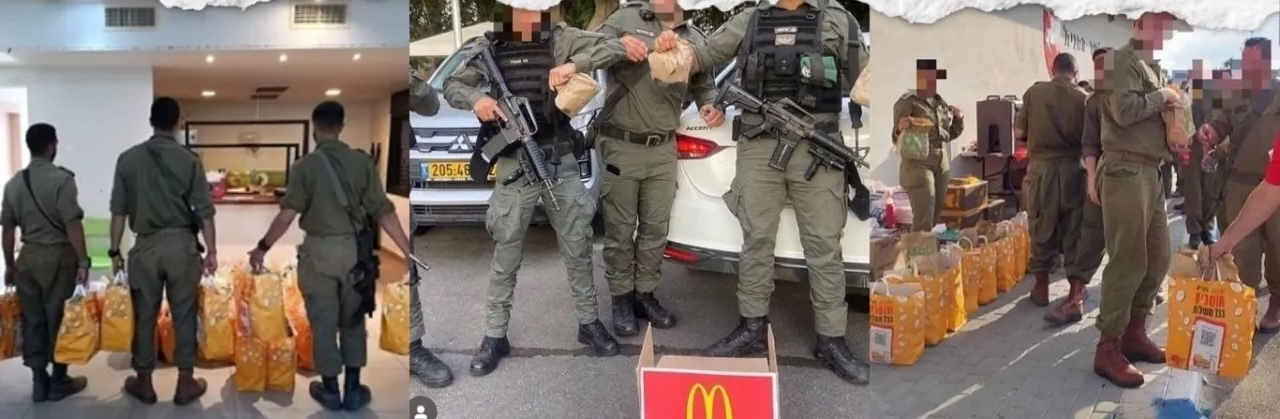
McDonald’s franchisee in Malaysia, owned by the Saudi company Lionhorn Pte Ltd, has filed a SLAPP or “shock-and-awe” lawsuit against BDS Malaysia, a solidarity group advocating justice and equality for Palestinians, accusing it of “defamation” and seeking damages for over $1 million. McDonald’s Israeli franchisee has supported the Israeli occupation forces with free McDonald’s meals during the ongoing genocide of 2.3 million Palestinians in Gaza, prompting the Palestinian BDS National Committee (BNC), the largest Palestinian coalition that leads the global BDS movement, to endorse the organic, grassroots-led worldwide boycott campaigns targeting McDonald’s to end complicity in apartheid Israel’s crimes.
Under the UN Guiding Principles on Business and Human Rights, parent and holding companies can be held liable for failing their due diligence duty when their subsidiaries, franchisees, or any other suppliers within their value chain are implicated in grave human rights abuses and violations of international law.
The actions of a McDonald’s franchisee cannot be isolated from the company’s worldwide operations. McDonald’s Corporation, Headquartered in Chicago, US, owns the McDonald’s brand and is responsible for ensuring that its franchisee is not involved in conduct that damages McDonald’s reputation, including any association of the brand with grave human rights violations.
Putting it simply, associating the McDonald’s brand with the Israeli army and its crimes against the Palestinian people cannot go without consequences for the company!
Since apartheid Israel launched its genocide in Gaza almost three months ago, organic grassroots campaigns to boycott corporations that support this crime against humanity have grown worldwide. The campaign against McDonald’s is one such organic campaign that became popular when the brand’s Israel franchisee donated meals and beverages to Israeli military personnel committing the genocide against Palestinians in Gaza and promoted this extremely provocative and racist form of complicity on their social media channels. The BDS movement, which did not launch this campaign, endorsed and encouraged it.
McDonald’s Malaysia is now bullying and intimidating BDS Malaysia — which has not launched this campaign either — because popular support for boycotting McDonald’s is growing in Malaysia and everywhere else. Instead of pressuring its parent company, McDonald’s Corporation, to terminate its shameful franchise agreement in Israel, McDonald’s Malaysia and its Saudi owner are desperately trying to silence voices of peaceful solidarity with the Palestinian liberation struggle in Malaysia. We cannot let this pass. Let’s show McDonald’s what grassroots boycotts can do.
The BNC calls on all supporters of Palestinian rights to escalate the global boycott of McDonald’s until the parent company:
Terminates its agreement with its Israeli franchisee over its support for Israel’s war crimes, crimes against humanity and genocide; and
Terminates its agreement with its Malaysian franchisee unless it drops its frivolous lawsuit against BDS Malaysia and apologizes for smearing the group and its leaders.
In order to raise the profile of BDS in the Netherlands and broaden the movement’s reach, docP is proud to announce that it has received permission from the BDS National Committee (BNC) in Ramallah to use the name BDS Netherlands alongside the well-known international logo.
In 2005, 171 Palestinian civil society organizations called for peaceful resistance against Israel. They issued a call for boycott, divestment, and sanctions (BDS) against Israel until it fulfills its obligations toward the Palestinians, in accordance with international law. The three objectives are:
Ending the occupation (and colonization) of the Arab territories occupied in June 1967 (UN Resolution 242) and tearing down the wall;
Recognition of the fundamental rights and full equality of the Arab-Palestinian residents of Israel (UN Convention on Apartheid);
Respecting, protecting, and promoting the rights of Palestinian refugees to return to their homes and property (UN Resolution 194).
To support the BDS movement in the Netherlands and to coordinate and facilitate BDS activities, the DocP Foundation was established in 2012 by the network “Working Together for Palestine,” consisting of Palestinian and other organizations in the Netherlands that advocate for Palestinian rights through BDS. The network has since been renamed the Council of Affiliates of docP.
The BDS movement has now become an integral part of the public debate. The movement is gaining strength worldwide and achieving countless victories. The BDS movement enjoys steadily growing support among peace activists, human rights defenders, anti-racism movements, labor unions, student organizations, churches, government agencies, and companies. Where the international community has failed for 70 years, civil society is stepping in.
There is also broad support in the Netherlands for the just cause and peaceful methods of the BDS movement, but not everyone knows where to turn or how to get involved. We would like to provide that support through the name and logo of BDS Netherlands.
Of course, this does not mean that we claim to “be” “the BDS movement in the Netherlands.” After all, that is not possible, because BDS is a movement in which anyone can participate. However, under the name and logo of BDS Netherlands, the docP Foundation aims to be more visible as a point of contact and representative of the BDS campaign in the Netherlands. The docP Foundation will continue to exist, but will henceforth use the name “BDS Netherlands” for its campaigns and in all its communications.
Israel’s apartheid regime now views the global BDS movement as a real threat due to its broad support, its many successes, but perhaps even more so because of its legitimate message and its peaceful methods. Just this week, the European Court of Human Rights unanimously ruled that calling for a boycott falls under freedom of expression. The Israeli regime is therefore doing everything in its power to silence the movement. It is therefore all the more important that we send a strong signal: the BDS movement is a fully legitimate movement with broad support from legitimate organizations and institutions, including in the Netherlands, and it will continue to exist as long as Israel refuses to fulfill its obligations under international law.
We therefore call on peace activists and human rights activists—in the broadest sense of the term—to endorse the goals of the BDS movement and to join BDS Netherlands.
Do you support the goals of BDS Netherlands and want to help with the BDS campaign? Then sign up to volunteer!
Veolia, long one of the main targets of the international BDS movement, has completely withdrawn from Israel. This is not only a major victory for BDS, but above all a warning to companies still involved in the colonization of Palestine: “Remember Veolia.”
The French multinational Veolia has completely wound down its operations in Israeli-occupied Palestine and withdrawn from the Israeli market. One could hardly imagine a more fitting gift for the BDS movement, which is celebrating its tenth anniversary this summer.
The Fight Against Veolia
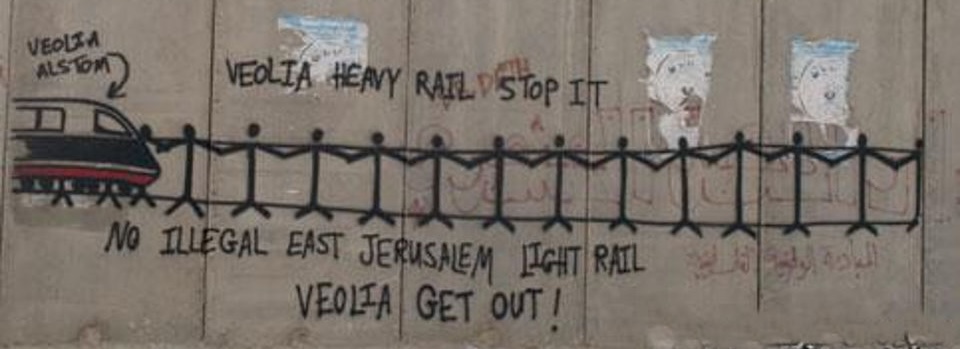
Veolia has long been a prime target of international BDS organizations due to its involvement in Israel’s occupation and colonization of Palestine. Until recently, the company was active in both public transportation and waste management for the illegal Israeli settlements, thereby contributing to violations of international law and human rights.
For that reason, Veolia faced opposition in every country where it operated or sought to operate. These actions cost the company more than 18 billion euros in contracts that were not renewed or were lost, and led Veolia to divest its interests in Israel. In September 2013, it sold its bus services, and in April 2015, its waste management operations. Last week, the company divested its remaining Israeli holdings in the form of Veolia’s stake in the Jerusalem Light Rail.
Does that settle the matter? No, certainly not. The monster created by Veolia lives on. Veolia leaves behind a tangible and operational infrastructure that remains in use to facilitate (among other things) violations of international law and the practice of apartheid. It stands to reason that the company should dismantle that infrastructure. Furthermore, Veolia will have to compensate for the tangible and intangible harm the company has caused to the Palestinians through its activities.
The next steps regarding the Veolia issue are primarily up to the Palestinians, and for that reason, DocP is awaiting the response from the BDS National Committee, which is expected in the coming days. We will report on it here on this site.
Dutch campaign
In the Netherlands, too, there has been an intensive campaign against Veolia, led in recent years primarily by the coalition Citizens Against Veolia. In cities, regions, and provinces, every available means was used to urge the exclusion of Veolia, and although success was not achieved everywhere, Veolia’s image continued to erode. It is certain that the widely supported Dutch campaigns contributed to Veolia’s change of heart.
DocP would like to thank the Citizens Against Veolia coalition, and everyone else in the Netherlands who has worked to campaign against this company in recent years. Veolia is proof that companies can be compelled to abide by the law through peaceful and legitimate means, but above all that involvement in the Israeli occupation and colonization of Palestine does not pay; it costs you your reputation, and if you’re not careful, your business.
Let this serve as a warning to companies that haven’t taken this step yet. Remember Veolia.